
Hedges are problem solvers. Privacy can be defended, an unsightly view blocked, or a large empty space filled with greenery and color. Beyond being practical landscape installations, hedges are also an opportunity to choose plants that you enjoy and that work with the overall design of the yard. Planning a hedge involves taking into consideration lighting, the size of the yard, level of maintenance desired, and how tropical or desert the landscaping is.
Much of the time, hedges in Phoenix are a long monotonous row of oleander. This plant has been popular in the low desert for many years because they grow well in full sun. On the other hand, they are extremely poisonous to people and animals, demand more water than desert plants to stay green, and send roots out to invade neighboring patches of grass.
There are so many other options for hedges in the low desert and many of them are colorful, drought tolerant, and attract beneficial pollinators. Here are some tips to build a hedge taking into account your space and your needs. At the end of the article is a plant list broken down into categories to help decide which hedge to build.
Space
Hedges aren’t one size fit all. Smaller spaces need smaller plants. Large plants like oleander and indian laurel planted in a small space need expensive trimming services regularly to keep them from overwhelming the space. Better to plant something with a smaller mature size to keep the hedge happy and full in a smaller space.
Very large spaces can create an opportunity to use trees as a hedge. Many small trees actually grow naturally like shrubs, with leaves all the way to the ground, but have their canopies raised regularly to maintain the appearance of a tree. Some trees require less trimming in a hedge because the shrub-like structure is actually desirable.
The distance between plants in a hedge is very important. It’s not necessary or recommended to plant large shrubs extremely close together (though I see it constantly in the valley!) in an attempt to make a hedge thicker sooner, because it can actually have the opposite effect. Planted too close together, the large shrubs struggle/compete to expand outwards and this results in bare trunks easy to see through.
Lighting
Most hedges are out in the full sun on a fence line. Only a handful of plants are tough enough to stay green and full in the sun here, which is why so many hedges look the same. But with a bit of shade in the afternoon there are many more plant options. Pay attention to the summer afternoons especially- if there’s no shade stick to the tried and true full sun plants to be safe.
Shady areas are very different. The reliable shrubs that line sunny fences will actually perform far worse in deep shade. Oleander, Texas sage, and other sun loving plants become spindly and grow slowly without enough sun. Since true shade is rare in Phoenix, it’s a great opportunity to use plants that otherwise can’t survive here.
Design
If part of a hedge is in full sun, and another part is in the shade (due to a tree or building), it’s better to have a hedge with two or more types of plants than to try forcing a full sun shrub to grow in the shade or a shady shrub to grow in full sun.
Hedges with alternating flower colors are common. A row of oleander might have half pink flowers and half white, one by one to make the hedge more visually interesting. I don’t tend to do that for a practical reason- if one of the plants dies, there will be an incredibly obvious gap where it used to be. A good landscape design is thinking five, ten, twenty years into the future.
Personally I prefer an element of randomness to make the landscape blend in a natural way. Blocks of color are impactful and it’s less obvious if a plant is gone. The rest of the yard can help determine where to put an accent – for example the view from a window can determine where to put a showy flowering block with yucca for texture, while less important sections can be made of something less showy.
In Phoenix we have many good desert plants to choose from, but there are also a surprising number of tropical looking shrubs that do well here. Decide the type of hedge based on the appearance of the rest of the yard for a more cohesive look.
Large space full sun
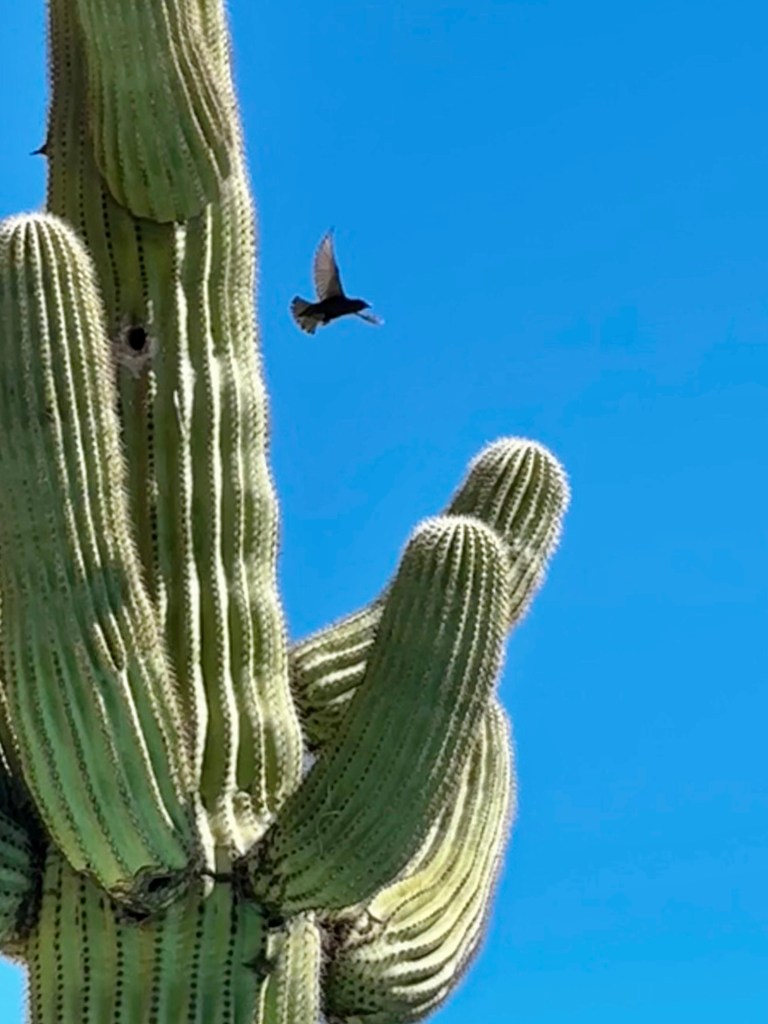
Orange bells (Tecoma x) (Mesic/transition)
Arizona rosewood (Vaquellia californica) (Mesic or desert)
Orchid tree (Blakeana x) (Mesic/transition)
Hopseed bush (Dodanea viscosa) (Mesic/transition)
Purple hopseed (Transition or desert)
Bush bougainvillea (Mesic/transition)
Creosote (Larrea tridentata) (Desert)
Desert lavender (Condea emoryi) (Desert) (mix with fuller shrubs)
Hackberry (Celtis pallida) (Transition or desert)
Jojoba (Simmondsia chinensis) (Desert)
Texas sage (Leucophyllum species) (Transition or desert)
Leatherleaf acacia (Acacia craspedocarpa) (Transition or desert)
Large space partial sun
Texas olive (Cordia boissieri) (Mesic, transition, or desert)
Sweet acacia (Vachellia farnesiana) (thorny, transition or desert)
Orchid tree (Bauhinia species) (Mesic or transition)
Privet (Ligustrum japonicum) (Mesic or transition)
Red tip photinia (Photinia x fraseri) (Mesic/transition)
Blue cape plumbago (Plumbago capensis) (Mesic/transition)
Skyflower (Duranta erecta) (Mesic)
Blue myrtillo cactus (Myrtillocactus geometrizans) (Desert)
Large space in shade
Natal plum (Carissa macrocarpa) (Mesic/transition)
Giant bird of paradise (Strelitzia nicolai) (Mesic)
Blue potato bush (Lycianthes rantonnetii) (Mesic/transition)
Smaller space full sun

Blue emu bush (Eremophila hygrophana) (transition or desert) (not a tall plant)
Tecoma Sparky Bells, Red Hot (Tecoma species) (Mesic/transition)
Texas sage Compacta, Little Lynn (Leucophyllum species) (Transition or desert)
Threadleaf, Silverleaf, or Feathery senna (Senna species) (Transition or desert)
Baja fairyduster (Calliandra californica) (Mesic, transition, or desert)
Bush lantana (Lantana species) (Mesic)
Smaller space partial sun
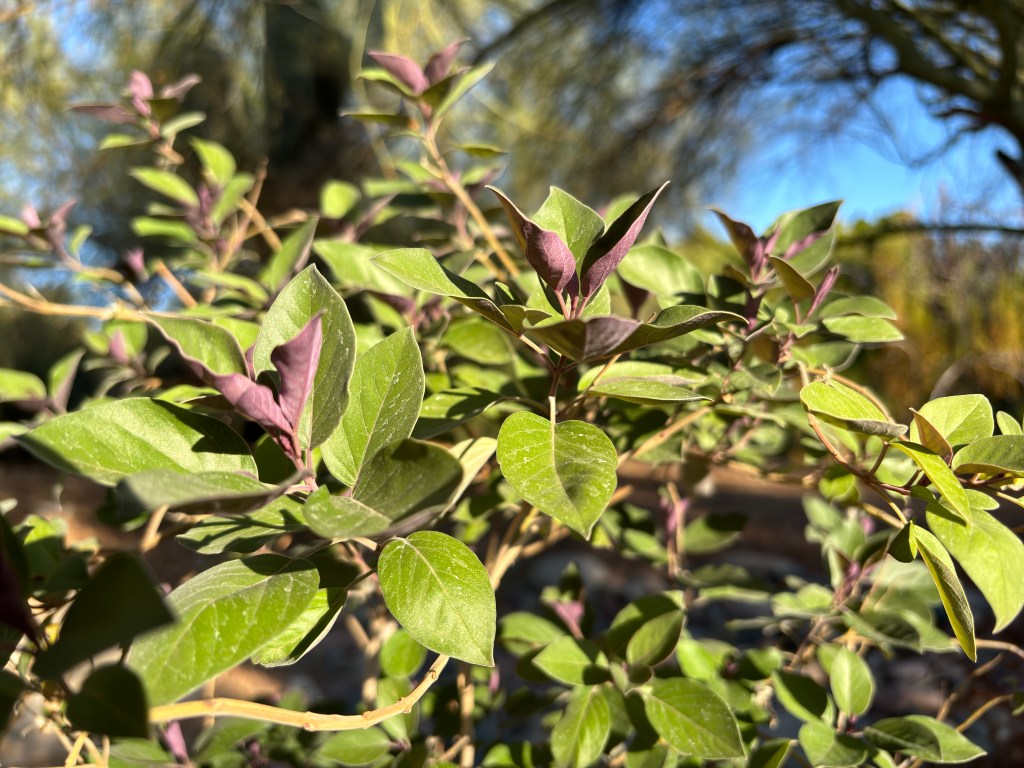
Slipper plant (Pedilanthus macrocarpa or bracteatus) (Mesic, transition, desert)
Coral fountain grass (Russelia equisetiformis) (Mesic/transition)
Asparagus fern (Asparagus densiflorus) (Mesic/transition)
Black dalea (Dalea frutescens) (Transition or desert)
Summertime blue emu bush (Eremophila x) (Mesic/transition)
Indian hawthorn (Rhaphiolepis indica dwarf cultivars) (Mesic)
Pittosporum (dwarf cultivars) (Mesic)
Available for homeowner consults
There are many more options depending on availability at the plant nurseries- I kept thinking of more while writing this article! Reach out for a personal consultation for your garden or an installation. I’m a certified nursery professional in the state of Arizona and a Smartscape landscape contractor, fully insured.
 Paige Maloney | Arizona Landscape Designer