
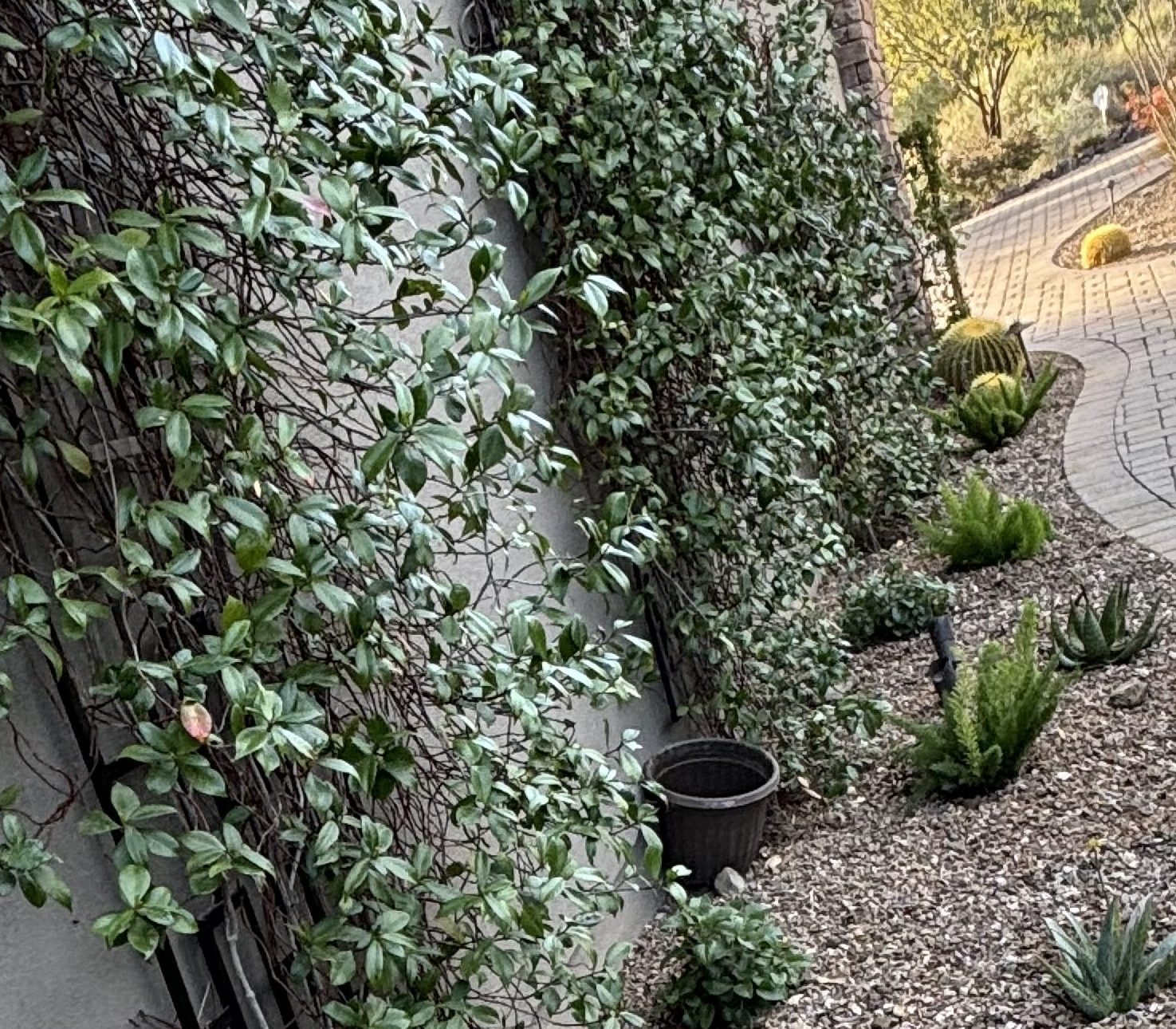
Some plants that are well known in other parts of the country are unfortunately not an option in the Arizona low desert. Plants like wisteria, hostas, and viburnum will be rarely found in the valley if at all, because the summer intensity and incompatible soil prevent them from growing well in Phoenix. But some beloved plants used widely in landscaping can also be planted in the low desert with a few modifications. Star jasmine is one of them.
When I lived in Florida as a kid, we had a wooden deck planted with star jasmine on three sides. They grew wildly in the full sun, filling the yard with the unmistakable sweetness of jasmine. Here in Arizona they don’t grow quite so easily, but it’s definitely possible to maintain healthy and blooming jasmine vines (Trachelospermum jasminoides). Placement is very important, and attention must be given to soil quality.
Where to Plant Star Jasmine in the Low Desert
Jasmine vines must be protected from the sun. They can be planted in full shade or light shade, such as a courtyard or under a shade tree. It’s important that jasmine doesn’t have to face the full afternoon sun during the summer because they will crisp and burn. If a jasmine is planted in too much sun it will struggle to grow or bloom, and will be stressed by the end of every summer even if it survives.
The happiest jasmine I’ve seen in Phoenix were planted on the north east side of a house, next to a walkway. They got about an hour or two of direct sun every morning and protection for the rest of the day. Those vines were thick and full, with glossy leaves, and bloomed regularly. Of course part of the reason those plants are doing so well is because the irrigation and soil quality supports strong growth.
Irrigation for Star Jasmine
This plant appreciates having regular water delivered at various points around the base of the vine. One emitter at the place where the trunk meets the ground is not sufficient! This will keep roots trapped at the base and surrounded by dry soil.
When I plant jasmine I like to add three emitters – one for the base, because that’s where the roots currently are, and two emitters about a foot away. This encourages the roots to grow outwards to find the water, which supports healthy growth and a resilient plant. After about a year I move the emitters farther away from the base of the plant because the roots are no longer confined to the base of the plant.
Every irrigation system is a little different but usually 1g or 2gph emitters are sufficient for about an hour twice a week. Freshly planted vines may need water every other day, especially through their first summer.
Soil Quality for Star Jasmine
Jasmine needs amended soil in the low desert. I always add a top dressing of composted mulch when planting, though potting soil or leaf litter work too. (Modern landscaping guidance says compost should be applied on top of the soil instead of underneath the plant because compost mixed into the backfill can unintentionally create a “bowl” effect where roots struggle to expand into the native soil.)
If the soil is hard or has a lot of clay it’s important to break up the soil to a width of three times the width of the pot of the plant. The soil should be either removed with a shovel or at least chopped up using the point of a shovel or trowel. This is to give the roots an easier time while expanding outwards from the base.
After installing the plant I like to add a thick layer of organic material all around the jasmine to enrich the soil. I put the emitters on top of the compost and use staples to secure them. I also like to add a bit of slow release fertilizer to help with transplant shock. Then I put the gravel mulch over the top of the compost without covering the base of the plant.
Star Jasmine in Pots
Jasmine also does very well in pots. Potting soil provides a high level of organic material and has a good water holding capacity. I like to add woodchips or other mulch as a top dressing to help keep the soil moist during hot dry days. Instead of emitters, I use loops of drip line for pots because it’s better to have the same amount of water spread out over the entire surface of the pot than to have two or three points where the soil is wet. Emitters in pots tend to leave areas of the soil dry while still emitting enough water to run out the base of the pot and create water stains or standing water in a saucer. Drip lines have very small emitters every six or twelve inches which provides better coverage.
Gardening in Arizona can feel very strange and unfamiliar compared to the way things grow in other parts of the US. But it’s mostly a matter of knowing which plants need protection and how to help them. Star jasmine is an option in the low desert, and it can thrive here. It just needs to be treated a little differently.
 Paige Maloney | Arizona Landscape Designer
Leave a comment